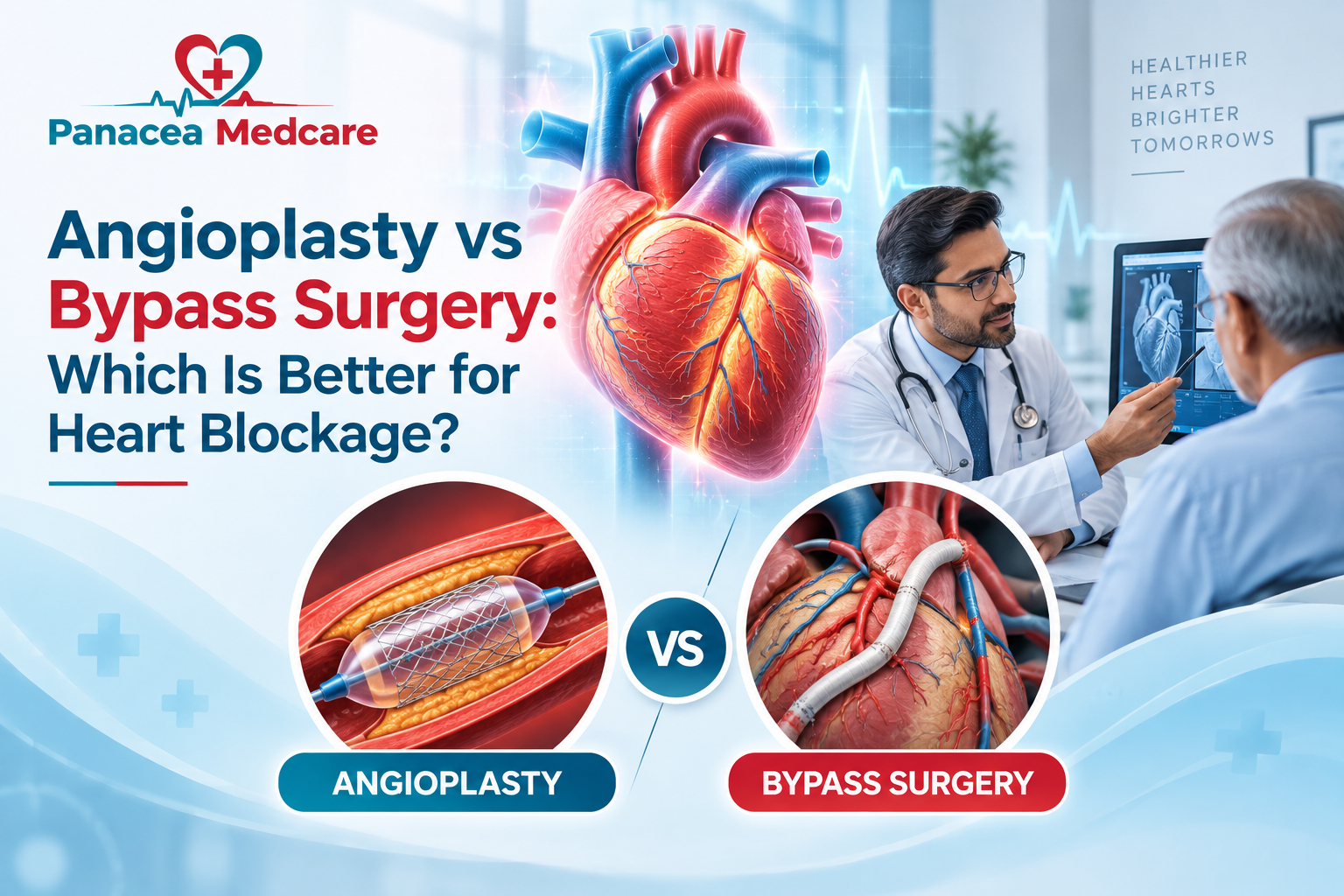
Angioplasty vs Bypass Surgery: Which Is Better for Heart Blockage
Your angiogram shows serious blockages in your heart arteries. Now your doctor says you may need angioplasty with a stent, or coronary artery bypass grafting (CABG). Both improve blood flow to the heart. Which one fits you depends on how many arteries are blocked, how complex the disease is, whether you have diabetes, how well your heart pumps, and your overall health.
If you’re comparing Angioplasty vs Bypass Surgery while looking at Heart Surgery in India and Cardiology Treatment India options, this choice matters even more. Some people do well with a minimally invasive angioplasty. Others, especially those with complex multivessel disease, get longer-lasting results from CABG.
Current guidelines say the same thing. Doctors should look at coronary anatomy, disease complexity, other health conditions, and the Heart Team’s view. No single rule fits every patient.
What Is Angioplasty?
Angioplasty is also called percutaneous coronary intervention, or PCI. A cardiologist uses a thin tube called a catheter to open narrowed or blocked heart arteries.
In Angioplasty in India, the cardiologist guides the catheter through an artery, usually in your wrist or groin, up to the blocked vessel. The doctor inflates a small balloon to stretch the narrow spot. Most of the time, the doctor then places a stent to hold the artery open.
Most PCI today uses drug-eluting stents. These release medicine that lowers the chance of the artery narrowing again.
If you’re looking for Medical Treatment in India, angioplasty often appeals because the hospital stay is shorter and you bounce back faster than after open-heart surgery.
What Is Bypass Surgery?
Coronary artery bypass grafting, or CABG, is a surgery that builds new paths for blood to travel around blocked heart arteries.
In CABG in India, the cardiac surgeon takes healthy blood vessels from your chest, arm, or leg. The surgeon then uses them to go around the badly narrowed sections.
Angioplasty fixes the blockage from inside the artery. CABG skips the diseased part and gives blood a different route.
Doctors may suggest CABG when the disease is widespread, affects several major arteries, or sits in a spot where PCI doesn’t work well.
If you’re an international patient thinking about Heart Blockage Surgery India, let the angiogram and a full heart check guide the decision. Don’t pick a procedure just because it sounds less invasive.
Angioplasty vs Bypass Surgery: What Is the Main Difference?
The biggest gap between Angioplasty vs Bypass Surgery is how each one treats the blocked arteries.
| Factor | Angioplasty / PCI | Bypass Surgery / CABG |
|---|---|---|
| Procedure type | Done through a catheter | Open-heart surgery |
| Treatment method | Opens the blocked artery, usually with a stent | Builds a new path around the blockage |
| Anaesthesia | Mostly local anaesthesia with sedation | General anaesthesia |
| Initial recovery | Usually quicker | Takes longer |
| Hospital stay | Usually shorter | Usually longer |
| Multiple complex blockages | Can work in selected cases | Often the preferred option |
| Repeat procedures | More likely in some patients | Needed less often |
| Surgical incision | No cut on the chest | Chest surgery needed |
| Best choice | Depends on coronary anatomy and health | Depends on coronary anatomy and health |
So the question isn’t just Stent vs Bypass Surgery. Doctors have to decide which revascularization method suits your coronary disease best.
When Is Angioplasty Usually Considered?
Angioplasty works very well when a catheter can safely reach the blockage and treat it.
One or Limited Number of Suitable Blockages
If you have one or a few focal narrowings, PCI can be a good fit as long as the anatomy allows it.
Acute Heart Attack
PCI plays a big role during a heart attack or acute coronary syndrome. It opens a suddenly blocked artery and restores blood flow fast.
The 2025 ACC/AHA guideline backs invasive treatment and complete revascularization for suitable acute coronary syndrome patients. The method depends on how complex the disease is and what other conditions the patient has.
Patients Who Need Faster Initial Recovery
PCI doesn’t open the chest. So most patients recover from the procedure faster than they would after CABG.
Still, a faster recovery doesn’t make angioplasty the best long-term choice for everyone.
When May Bypass Surgery Be Better?
Doctors often think about CABG when the disease is widespread or hard to treat with a catheter.
Multiple Blocked Coronary Arteries
For Multiple Blockage Treatment, CABG may win out when several major vessels have severe disease, mainly if the anatomy is complex.
The 2024 European Society of Cardiology guidance on chronic coronary syndrome covers this. In people with complex multivessel disease, especially those with diabetes who could have either treatment, CABG has been linked to longer survival than PCI.
Diabetes With Multivessel Disease
Diabetes can sway the decision because the disease often spreads more widely along the arteries.
For people with diabetes and complex multivessel disease, international guidance has often leaned toward CABG over PCI when both are possible.
Complex Coronary Anatomy
Bypass surgery may fit better when you have long lesions, heavily calcified vessels, widespread disease, certain left-main patterns, or trouble in several coronary branches.
Reduced Heart Function in Selected Patients
Some patients have a weak left ventricle along with extensive coronary disease. Surgery may help them over the long run. The ESC reports better long-term survival with surgical revascularization in selected patients with ischaemic cardiomyopathy.
If you’re exploring Cardiac Surgery in India, ask a multidisciplinary Heart Team to review your angiogram and heart function, especially when the right choice isn’t obvious.
CABG vs Angioplasty: Which Has Better Long-Term Results?
There’s no clear winner for everyone.
PCI is less invasive and gets you back on your feet sooner. CABG can give longer-lasting results for some complex blockage patterns.
Repeat Treatment
One big difference is the chance of needing another procedure down the road.
The ESC notes that people treated with PCI generally need repeat revascularization more often than those who have CABG. That holds true even with modern surgical methods and newer stents.
Survival Depends on the Patient Group
When the disease is less complex, either treatment can make sense. Your anatomy and your own preference help decide.
When the disease is complex and affects many vessels, particularly with diabetes, CABG may lead to better long-term outcomes.
That’s why you should judge CABG vs Angioplasty using your own angiogram. A generic comparison online can’t do that for you.
What About Stent vs Bypass Surgery for Three Blocked Arteries?
Many patients ask if three blocked arteries always means bypass surgery.
Not always. But it does make CABG more likely to come up.
Doctors look at:
- Which arteries are blocked
- How severe the narrowing is
- How long the diseased stretch is
- Calcium buildup
- Left-main involvement
- How well the heart pumps
- Diabetes
- Age
- Kidney function
- Surgical risk
When the anatomy is fairly simple, multivessel PCI may sometimes work. When the disease is widespread or complex, CABG often suits better.
The 2025 ACC/AHA acute coronary syndrome guidance agrees. It says the choice between multivessel PCI and CABG should reflect how complex the coronary disease is and what other conditions the patient has.
Recovery After Angioplasty vs Bypass Surgery
Recovery is where the two procedures differ most clearly.
Recovery After Angioplasty
After a straightforward PCI, many patients are up and walking soon. Some go home quickly, depending on their condition.
Activity limits usually last a shorter time. Medicines still matter a lot, particularly the antiplatelet drugs you take after a stent.
Recovery After CABG
CABG takes longer to recover from. Your chest and the spots where surgeons took the grafts need time to heal.
You’ll likely stay in the hospital for monitoring first. After that, you’ll spend several weeks building back strength, often with cardiac rehabilitation.
If you’re an international patient planning Medical Travel India, let medical clearance set the length of your stay. Don’t base it on the earliest possible discharge date.
How Much Do Angioplasty and Bypass Surgery Cost in India?
The price depends on the hospital, the number and type of stents, the complexity of the PCI, how many bypass grafts you need, your room type, whether you need ICU care, and your other health conditions.
Angioplasty in India often costs less than CABG at first. But several high-end stents can significantly increase the final bill.
CABG in India usually costs more. It needs an operating theatre, a cardiac surgical team, ICU care, and a longer stay.
International patients should ask for an itemized estimate that covers:
- Cardiologist or cardiac surgeon fees
- Angiography
- Stents, if needed
- Surgical grafting
- Anaesthesia
- ICU stay
- Hospital room
- Medicines
- Investigations
- Follow-up
A trustworthy Medical Tourism Company in India will explain what’s included before you book your travel.
Angioplasty vs Bypass Surgery for International Patients
If you’re travelling abroad, settle the medical decision before you plan the logistics, whenever you can.
If you’re looking at International Patient Services in India, send these:
- Coronary angiogram
- Echocardiogram
- ECG
- Blood investigations
- Cardiac history
- Current medicines
- Records of past angioplasty or cardiac surgery
With Doctor and Hospital Matching, an interventional cardiologist and a cardiac surgeon can both look at your case when the right path isn’t clear.
A Second Medical Opinion in India helps a lot when one doctor says PCI and another says CABG.
How Panacea Medcare Helps Heart Patients
Panacea Medcare acts as a Medical Tourism Facilitator in India. The team helps international patients with cardiac evaluation, hospital selection, treatment planning, and travel support.
Specialist Review Before Travel
You can send your angiograms and cardiac reports before you travel. Suitable cardiologists or cardiac surgeons then check whether Angioplasty vs bypass surgery is the question to ask in your case.
Hospital and Treatment Comparison
Panacea can line up options across hospitals that offer advanced Heart Treatment in India. That covers PCI, CABG, valve procedures, TAVR, and other cardiac services.
Transparent Cost Estimates
Once a specialist reviews your case, you can get an approximate estimate for the procedure and hospital stay before you book any international travel.
Medical Visa Assistance
If you’re travelling mainly for treatment, you can get help with Medical Visa Assistance and the hospital paperwork you need for the trip.
Airport Pickup and Accommodation
Panacea can arrange Airport Pickup and Accommodation Support. You and your attendant can stay close to the hospital that’s treating you.
Admission and Follow-Up Support
The team can also help with hospital admission, appointments, and Follow-Up Care. Where possible, that includes staying in touch with your treating doctors after you get back home.
Conclusion
Choosing between Angioplasty vs Bypass Surgery takes more than asking which one is quicker or less invasive. Your coronary anatomy, the number of blocked vessels, diabetes, heart function, age, surgical risk, and long-term goals all count.
Angioplasty can treat many blockages well with a minimally invasive approach. CABG may last longer for patients with complex multivessel disease and certain high-risk profiles.
If you’re an international patient looking for Medical Treatment in India, Panacea Medcare can set up a specialist review, hospital selection, treatment estimates, medical travel, and recovery support.
Share your coronary angiogram and cardiac reports with Panacea Medcare to compare angioplasty and bypass surgery options before you travel to India.
Frequently Asked Questions
Is angioplasty better than bypass surgery?
Neither one wins every time. Angioplasty can suit less complex coronary disease. CABG can be the better pick for some patients with widespread multivessel disease, diabetes, or complex anatomy.
Is bypass surgery better for three blocked arteries?
Doctors often consider CABG for complex three-vessel disease, mainly when diabetes or extensive coronary disease is involved. Still, some patients may do fine with multivessel PCI after a specialist checks them.
Which procedure has faster recovery?
Angioplasty usually has a faster early recovery. It uses a catheter and doesn’t open the chest. CABG takes longer to recover from, but it may last longer for some patients.
Can patients get a second opinion before travelling to India?
Yes. International patients can send angiograms, echocardiograms, and their medical history for a specialist review before they travel. They can compare treatment advice and get an approximate cost estimate.
Does Panacea Medcare arrange cardiac treatment in India?
Yes. Panacea Medcare helps international cardiac patients with specialist and hospital selection, treatment estimates, medical visa support, airport pickup, accommodation, hospital admission, and follow-up.